
|

The attack started as predicted, across the river. The government soldiers were said to be surrendering en masse. After an initial flurry of activity the City seemed deserted. When the boy went to sell his cans he found the yard closed. The traders had gone. Suddenly around midday there were prolonged bursts of firing and a column of jubilant rebels entered the City crowded on jeeps and old trucks - shooting victoriously into the air.
Desested The street people and garbage children joined in the celebrations but few others did. Most people stayed in their homes. There were no cars on the streets. Even the monks did not leave the temple. Next day the people’s fears were realised as the rebels announced through loudspeakers that everyone had to leave. The entire population was ordered out of the City and no one was allowed to take more than they could carry. “The City is corrupt,” declared the rebels. “From now on there will be no city, no offices, no shops, no banks, no money no temples, no schools, no television, no radio. Everyone will work on the land. Everyone will grow food.”
All out! Rebel soldiers moved into every street and searched every house in turn, making sure that no one was staying behind. As the people were herded out of the City they had to pass checkpoints where they were inspected. Anyone with clean soft hands joined a separate column. These included traders, shopkeepers, teachers, monks, judges, politicians, policemen, and doctors. All these men and their wives and families were detained in the compound of the City high school that was now ringed by barbed wire and guarded by soldiers. “They are kept for interrogation,” ran the rumour darkly. The boy and his companions joined the other procession out of the City into the countryside.
Guilty or not? For most families these were very difficult days. The rains had not ceased and the roads, destroyed by the war, turned into muddy quagmires. Children cried, mothers quickly exhausted their supplies of food. The armed guards shot anyone picking food. The villages they entered could not or would not help them. Each day the suffering grew worse. The street children, who were used to scavenging found it hard to scrape together enough to survive, but for others unused to rough living it was far worse. Old and young dropped by the roadside, collapsing from hunger or thirst, fever or diarrhoea. The armed guards showed no sympathy. Anyone who could not stay on their feet was clubbed to death or just left to die.
Drop dead At another place they were inspected again and the fitter ones taken aside. “You will be a soldier,” they were told. “And you must trust no one. There are enemies of the revolution everywhere. Everyone who had anything to do with the old corrupt regime is a spy. Naturally for their own protection they will try to pretend they had nothing to do with it. They will claim they had humble jobs, but you will be able to catch them out, by the way they speak, the way they act.” “If you suspect anyone - even your close friend, your wife, your husband, your father, it is your duty to report them. It is your duty to betray your neighbour. Not to do this is to betray the cause and to betray yourself.”
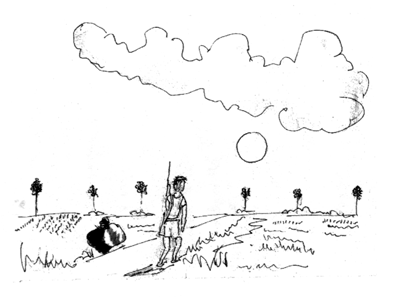
You’re a soldier now Instead of a sack of rubbish the boy now carried a gun. He still wore the same ragged clothing; torn T-shirt and shorts and broken flip-flops, but as a badge of his new role he had a red scarf tied round his head. The new recruits were given basic training - which amounted to little more than learning how to clean and fire their rifles, throw a hand grenade, place a landmine. Whenever they wanted to rest they had to listen to revolutionary propaganda about the evils of the City and the corrupt people who lived there. But the City seemed far off in his memory, and as for the Garden, it was like a dream, and he began to doubt it had ever existed.
Lesson of war
|
||
|
Part 1 - Part 2 - Part 3 - Part 4 - Part 5 - Part 6 - Part 7 - Part 8 - Part 9 |



| . |
|


| . |
