
|

The war that had been raging outside the City grew closer and sometimes they could hear the sound of gunfire and explosions. One of the immediate results was that more and more refugees crowded into the City and shanty towns of thatch and plastic and cardboard grew up along the swamps and the river banks.
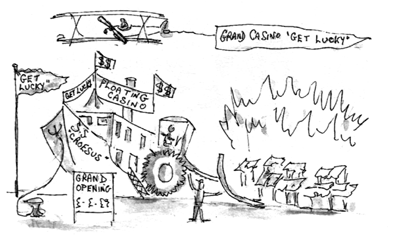
Cut… From time to time - usually when some important visitor from overseas was coming, or an international meeting was due to take place - the police arrived in force and tore down the huts and herded the refugees away in trucks, On these occasions the beggars and garbage boys kept out of sight, but one day the boy unexpectedly found himself in the middle of a violent demonstration. Confronting the armed police and pelting them with stones stood a crowd of desperate people the police were trying to evict from their shacks. The boy was astonished to see his friend, the foreign lady, in their midst. She took him aside. She was very angry. It’s disgraceful - all these people’s homes are being torn down to make way for a floating Casino - where the rich can gamble their money.”
Stop! Near them stood a man wearing what had once been a smart suit. Ho looks like one gambler who lost,” said his foreign friend. The man overheard and shook his head. “Did you lose your job?” asked the boy sympathetically. The man nodded, “I was a bank manager but I lost faith in money.” The banker peered at the boy. “Do you know what a bank is?” “It’s where rich people put their money.” “Exactly I And all day long like a river money flows in and money flows out. Figures, lists, graphs, float like weeds in this river of money. Only you have to believe in it.”
Money?... “So long as you believe in the system you swim, but the moment you stop believing you sink.” “And you didn’t believe in it?” “Of course I did at first. Why, as a young man in the bank I was all bright-eyed and eager and raring to go. But when you handle thousands and thousands of Dollars and Francs and Ringits and Pounds and Marks and Lire and Baht and Pesos and ... Why, money starts to lose its appeal. It stops meaning anything. “After all it wasn’t my money and I never took it out of the bank. I began to question the whole value and notion of money. All these deposits people spend their whole lives saving and will never spend when they’re dead. I began to tell customers that what they should be investing in was the next life. Gilt-edged securities of the soul, not the Government Treasury.”
Securities of the soul He made a wry grin. “Of course they thought I was just crazy, but my boss knew I was dangerous. You see, the Capitalist system only works, only keeps roaring ahead as long as everyone believes in it. The system relies on confidence and conviction. Once this gets punctured - why, the whole caboodle can collapse overnight.
“Capitalism is only a bright shining bubble - pop it and it bursts into nothing. International financiers juggle currencies like baubles for profit when these same currencies are the bedrock of a nation and assure the livelihood of millions of people. The whole system is founded on the rotten idea that greed and gain are good. The only capital that counts is what you store in your heart not in the bank.” “What will you do now?”
What is wrath? “I am waiting for the revolution to come,” he said placidly. “They tell me these rebels don’t believe in money either. They say they’re going to do away with it altogether and put everyone back to planting rice, It sure makes sense to me.” The foreigner who had been arguing with the police came back bloodied and bruised with her blouse torn. “They have no respect for human rights,” she complained bitterly. “No respect at all.” “What are human rights?’ asked the boy, but the foreign lady was too busy handing out money and medicine to the distraught people whose huts had been burned or town down to reply.
Human rights? Later she took the boy aside. “Every human being has rights,” she told him,’ - the right to some sort of house, however simple; the right to get water, to work, to live without harassment - it’s not asking much, is it? And it’s the responsibility of a government to help the people to obtain their rights. They should be protecting these people.” “The government is just the big boss,” said the boy. “Why should it listen to anyone?” “A government is meant to be there to serve the needs of the people - not just to get rich themselves. You want something here - then you buy the politician. Somebody wants to bring a casino here - even though gambling is officially ‘illegal.’ It means nothing that people live here. Or even pay annual taxes for their shanty huts - these are bulldozed away like dirt. And, if they object, or don’t go or protest… “ she slid a finger under her throat.
Lucky for some Then she shrugged. “But they say I’m just an interfering foreigner. They say these people are used to this system, and wouldn’t understand democracy. And you know what democracy means here - vote buying.” “What is a vote?” enquired the boy. “A vote is your choice. In democracy every adult, rich or poor, has a choice. But some are scared to use it, others don’t care and some sell their choice to people who want to be chosen to govern and who buy as many votes as they can.” “So the wealthy ones get chosen?” The woman nodded. “They have to get their money back so they do all sorts of corrupt things. Businessmen have to pay them to get contracts; so does anyone else who wants their help.
What’s it worth? “Where I come from everyone has the right to an education, free access to hospitals, money if they can’t find work, and the right to a pension when they are old. But I daren’t tell people that here.” “Nobody would believe you if you did.” The woman laughed “The funny thing is over there everyone takes it for granted. They complain far more there than they do here. Over there they think they are badly off if they can’t afford a new car.” Once again she and the boy shared a laugh together and felt the better for it. The question of human rights seemed to be about to answer itself when the boy passed a deserted-looking building with a peeling board outside announcing ‘Office for Protection of Human Rights.’
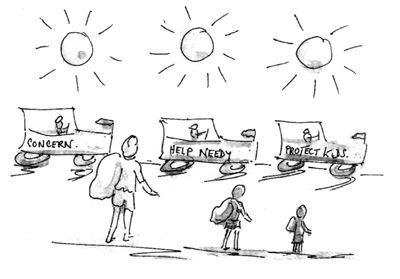
Is this for me? There was certainly plenty of waste paper and crumpled leaflets in the bins, but no one to question what it all meant. Finally he saw a man emerge and asked him. “Don’t worry yourself,” he assured the boy. “It’s got nothing to do with you.” The City was full of similar buildings with similar foreign-sounding names. Red Cross, World Vision, Save the Children, War on Want. There were usually large white jeeps in the courtyards and security guards to ‘shoo’ anyone away. Sometimes he saw the jeeps with their bright emblems and flags roaring along the streets but nobody seemed to know where they where going. When the boy asked he always got the same answer: “It’s some foreign thing.”
Saving the world? “They have nothing to do with us.” Often in the early evening the boy came across the foreign lady - only now she was back on her bicycle. “I really do NEED it!” she cried breathlessly. The front basket was filled with packets of steaming rice and hard boiled eggs and bananas, which she was handing out to homeless people or hungry children. “Phew!” she said, mopping her brow. “Sometimes I think if the bicycle was edible they’d eat that too” She always carried a big first aid tin which seemed to contain a little of everything: headache pills, cures for diarrhoea, creams to heal rashes, tablets to stop fever and toothaches, even fillings for cavities. “I’m a ‘band-aid’ girl,” she told the boy. “A lady bush doctor: Bible, band-aids and bicycle.” “What’s a bible?” asked the boy.
Between the lines? The lady smiled. “It’s a book that helps me on my journey. Lots of good things in it,” she added a bit mysteriously. “Can you read?” she asked the boy. “Just a bit. The big letters,” the boy smiled. “Then at least you can’t read between the lines,” laughed the lady. This puzzled the boy and when he next got hold of newspaper he tried hard peering between the lines of print but gained nothing except an eye-ache. If street people got sick they just lay there till they got better. There were old women who knew about healing. They didn’t use the tablets or lotions of the foreigners, they believed in thrashing with a branch. Across the chest - if you had a cough. The thrashing brought the blood to the surface and helped the circulation; or there were hot suction cups applied to the skin to draw out the pain. Only the rich people went to doctors. “And they usually choose an old one,” someone explained. “The older ones have already learned by their mistakes on earlier victims.”
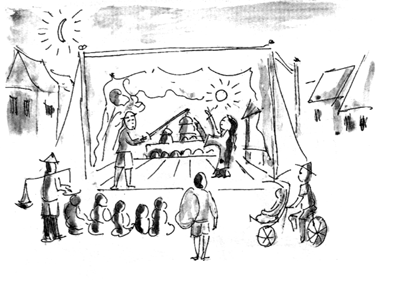
Street surgery Doctors handed patients letters for shops that sold medicine, but ordinary people didn’t trust the pills and potions, as they doubted what was in them. Often - so it was rumoured - they were nothing more than flour and sugar. Sometimes in the evening the people of the street were entertained by actors who set up a stage and dressed in fancy costumes, danced and sang and told stories. Always they were dressed up in costumes no one wore any more and the stories were of olden times - of heroes and villains and tragic romances.
Street theatre There were other theatres for rich people - but these were out of sight and you had to pay to go in. One day the boy, who was collecting bottles outside the stage door, met one of the players. Unlike the friendly street actors this one seemed rather stuck up. He was practising his lines. “Each week,” he explained loftily, “I have to learn my pan for the next week’s play.” “Don’t you ever get muddled up?” asked the boy. “Of course not,” snapped the actor. “After all I’m a professional. It’s my job to pretend to be someone I’m not.” The boy looked confused. “Why?” “A play,” explained the actor, “is a copy of life, but all condensed into a couple of hours - dramas, murders, love. Art copies life,” he pronounced with authority.
Art copies life? “Why do you need to copy life?” asked the boy. “I should have thought you’d want to escape from it.” “Of course it does that too,” agreed the actor. “In the theatre are the actors and the audience. The actors enable the audience to identify and explore their emotions. Oh, how they laugh or cry at our performances! A well-acted play brings out their finest feelings. They can get back into their lives like new people.” The boy was puzzled. But does it help them for long? Most of the people I seem to see coming out of theatres are the same people who went in.” “The theatre is not supposed to be a religion,” said the actor huffily. “It’s only an illusion after all. A bit of a trick.”
Coming or going? “But if it’s supposed to copy life then life must be an illusion too!” protested the boy. The actor snorted indignantly. ‘1 haven’t the time to bandy words with garbage boys!” he declared. “I have to learn my lines. Next week I have a very important part. I am a lawyer - I have to impress everyone with my cunning.” He glared at the boy with lowered eyelids. When he went to the river the boy met a man carrying a large folding easel and a box of paints, blank canvasses, tubes, rags and bottles. He seemed on the point of dropping things and as the boy’s sack was still half empty he helped the painter with his load.
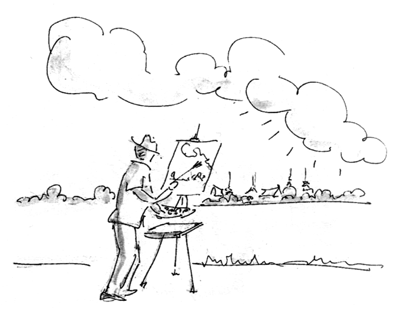
Stealing the light “What are you doing?” he asked as the painter set up his easel on the riverbank and squirted paints onto his palette. “Are you copying life like the actor?” “No,” smiled the painter. “I am a thief.” He winked at the boy. “A thief?” repeated the boy, startled and backing away. The painter laughed. “I steal light! Now, look over there.’ He guided the boy’s hand and pointed to where the late afternoon sunlight was glowing from beneath the lowering clouds. The glow spread to the golden roofs of the royal pagoda. The painter sighed. “That is what I want to capture, to put down the light.’ He shook his head.
A word of God His silver hair and grey moustache all glowed in the reflected light but the canvas remained blank. “Aren’t you going to paint anything?” the boy suggested after a while. The old painter spread wide his arms. “Sometimes I am just so amazed at the beauty of light,” he said, “I just want to share its mystery. Light,’ he said majestically, “is a gift of God, a word of God. A whole language like silence.” “Like the sky,” said the boy thinking of the Swan. “And the light shines in the darkness and the darkness doesn’t understand,” added the painter softly. “What is that?” asked the boy. “It comes from an old book - written a long time ago,” said the painter, “but the line I like best is: ‘God is Light. In Him is no darkness at all.’
God is light “Light doesn’t just come from the sun,” he told the boy, “Light shines from the love of God.” He pinched together his fingers as if to trap a glimmer. “And a little of that light glows in each one of us. If we let it.” “You are not a painter. You are a priest,” said the boy. “No,” said the painter with a laugh. “I am a thief of light, but not a very successful one.” The full moon towards the end of the year marked the festival of ‘candle floats.’ The day of the festival was busy with preparations, and towards evening everyone carried their floats to the river bank. The breeze died with the sunset. The air stilled, and as the fuN moon rose above the darkening river the candle-lit floats were set gently on the water’s edge and drifted slowly out into the stream.
Pray for peace The boy met his friend, the elderly monk, who was gazing placidly at the scene. “Why?” asked the boy. “Why?” replied the monk. ‘When you peer into a candle flame don’t you wish or dream?” The boy nodded. “Everyone is aware of their own frailties,” remarked the monk, watching the river now invaded by thousands of flickering candles. “We get comfort from these gestures we make together, sharing our hopes and fears.” “But if the candles go out?” asked the boy, anxiously following his own float, “doe’s that mean our dreams will die too?” The monk smiled. “The sun goes out, but tomorrow still comes.” “Then what should I pray for?” asked the boy, thinking only of the Black Swan and the Garden. “Pray for peace,” the monk suggested. Shortly after the festival of candles, the annual kite flying began. This wasn’t just for children - everyone joined in. Most people made their own kites. Sidewalks and table-tops were strewn with coloured paper, glue, sticks and string. Street vendors did a brisk trade. The poorer children cut out plastic bags or newspapers. Day by day the afternoon sky filled with kites of every shape and size. Looking like birds and bats, dragons and owls, they swooped and darted, soared and plunged, to the accompaniment of shrieks and laughter and howls of glee.
Soaring aloft Judging by the cluster of kites rising above the pagodas, even the young monks joined in the sport. The old monk shaded his eyes to watch. “Are these like our dreams, too?” the boy asked him, thinking of the floating candles. “Perhaps they are,” nodded the monk, “but I think it’s rather as if our spirits were soaring with them.” He smiled. “Look around - do you see any glum faces?” As the boy craned his head back to scan the sky his delight was tempered only by a wistful longing to be up there too, flying high through the bright, thin air.
|
||
|
Part 1 - Part 2 - Part 3 - Part 4 - Part 5 - Part 6 - Part 7 - Part 8 - Part 9 |












| . |
|


| . |
| . |
