
|

One morning near the market the boy met a man selling wood. He looked very poor. His clothes were full of holes and he was barefoot. He was selling bundles of f ire- wood tied on the back of a broken-down bicycle. The man seemed cheerful and unworried. ‘You look very poor,” said the boy, concerned.
I’m not poor….
“I’m not poor,” exclaimed the man indignantly. “I have a lovely wife and 13 children. I’m not poor!” The boy looked puzzled. “And you earn enough to buy them all food?” The man nodded, ‘Just enough. But I’m not poor. I’ll tell you what being poor is. Being poor is not having a wife, and not having children.” “Being poor is to be sick, or lonely or sad because someone you love has died or gone away. I have a good wife and 13 wonderful children.” He pointed to a passing limousine and told the boy “those people may think they are rich - but in many ways they are poorer than I am with all their worries and problems.” He dusted his ragged clothes and sat down beside his bicycle. “No, I’m not poor,” he replied.
The best meal ever… He invited the boy to eat with him. He had only some stale rice and water but he shared this with as much ceremony as if it was a great feast. Afterwards the boy thanked him, bowed and told him with total sincerity, ‘That was the nicest meal I’ve had,” The yard man, who was looking on, beckoned the boy. “Tonight you come and eat with me.” The boy was puzzled, for the yard man was very mean That same evening the yard man gave him yesterday rice, crusts and water. Unlike the wood seller the boy knew the yard man gave him this food just to save money. ‘That’s the worst meal I have ever eaten,” he said truthfully. The yard man became angry. ‘It was the same meal you had with the wood seller and you thanked him.” The boy just shook his head. How could he begin to explain the difference if the man did not know himself. “For the wood seller it was the most he could offer. For you it was the least,” he told him.
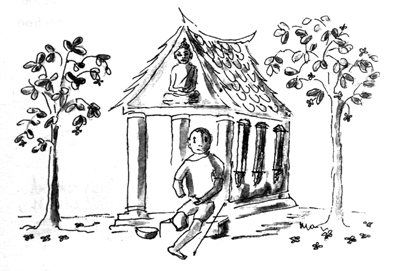
Walk and run? At least if the boy was poor he could still feel thankful that he could walk and run, see and swim. For in that City there were thousands of young and old who were blinded and maimed by a war that was raging outside the City - and every day came a little closer. It was not only soldiers who were wounded but country people ploughing their fields who stepped on landmines, or children walking to school or mothers collecting firewood, boys cutting bamboo. A boy without hands or eyes sat by the Royal Pagoda of the King each day, begging. He explained to the boy how he had bent down to cut bamboo and something went bang and since then his world was black as night. And the boy felt tears start in his own eyes - for even sadder was to see the empty bloodied sockets in the child’s face where not even tears could flow.
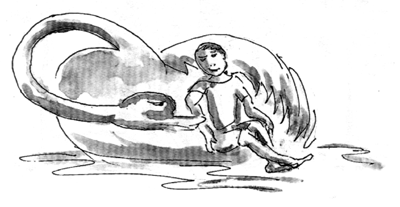
No eyes, no tears? Later that day he returned to the pagoda with food to share with the boy, but he was not there. “They take him away each night,” he was told. ‘They’ were not his parents, but traders who bought maimed children and put them out each day to get money by begging. The boy felt very sad; he carried his food to the river bank but felt too unhappy to eat. In the dusk he heard the beating of wings and looking up saw the shadow of the Black Swan landing beside him. “Do you want to go back to the Garden? Have you seen enough?’ The boy lay his head on the downy breast of the Swan. He said to the Swan, “But there are thousands and thousands who have no one to comfort them. No one to fly them back to the Garden. If I go away now I will always take the memory of their suffering with me. And I will never feel free as I was before.”
Have you seen enough? “Now less than ever will I be able to fly. The City is like a dead weight dragging me down. It’s not just the suffering but the filth, the noise, the greed, the hunger, the injustice, the anger, the lack of concern The boy’s voice trailed off wearily. The Black Swan covered the boy’s defenceless head with the shadow of his wing and spoke. “Once long ago everyone lived in the Garden but people took it all for granted and started to abuse it. They chopped the trees and ate the animals and killed or imprisoned anyone who disagreed with them. They behaved as if they owned the Garden when really they were lust guests like everything else. One day they decided they were every bit as clever as God and agreed among themselves to take over the Garden completely.
God’s favourite tree… “In the middle of the Garden there was a favourite tree God had planted and ordered no one to ever touch The leaders of the people made everyone very excited with wild speeches and an unruly mob marched to the tree, cheering wildly, and chopped it down. “They had thought they could be as wise as God but instead they argued and fought and behaved worse than ever God decided to get rid of them all by causing a great flood to wash the Garden free of them. Before He did this He decided to share His plan with the only good man left “He instructed him to build a great raft and put on board two of every plant and animal living in the Garden, so that when the flood came they would be saved and that afterwards the Garden could be made again. Of course the man’s neighbours all laughed at him for building this huge raft. Later when the rains poured down in a never-ending deluge their laughter fell silent.
All aboard? “They watched in despair as the river burst its banks and floods swept over the Garden drowning everything and everyone. Now the people begged and pleaded to be allowed on board the floating raft. But God’s resolve was not shaken and the raft sailed away without them. However, their cries and suffering so touched the heart of God that He decided no matter what crimes mankind committed in the future He would never interfere again. “Instead He would send messengers and prophets and teachers to try and persuade the human race how it should live with itself. When the floods subsided God knew that although He would create another Garden in the curve of the great sandy river, man alone would be forbidden to enter. But He made a promise that they could return to it one day.”
Keep Out! The boy fell asleep and dreamed he was back in the Garden, lying in the cool shade beside the river and the Black Swan was fanning him gently with his wing as he spoke to him. “The trouble was,’ the Black Swan continued in the boy’s dream, “the people kept forgetting or ignoring God. Once. God chose a particular man to be their leader. “He led them through the wilderness - through deserts and mountains, through famines and plagues - all with the one purpose of purifying them so they could return to the Garden. God even wrote down His laws on tablets of stone and gave them to this leader to show the people so they could have no excuse to ever forget again. This leader was very close to God! Each day he climbed to the mountain top to receive God’s instructions. One day he asked to see God with his own eyes.
God passed by… “God replied, ‘Not even you, my chosen friend, can see me. But if you hide behind a rock and keep your eyes shut tight I will pass close by and you can feel my Glory.’ So the man did as he was told and God passed by. It was like a mighty rushing wind.” In his dream the boy looked up at the Swan. “Is that what God is like?” “God is like everything and nothing,” said the Swan. ‘One man asked if God is to be found iii the heart of the hurricane or in the fiery inferno of a volcano, in the roar of thunder or the flash of lightning. ‘No,’ said God, ‘Look for me in the still small voice of calm.’
serenity “A prophet,” continued the Black Swan quietly, “promised God would come Himself. He claimed that the Spirit of God would be born in an ordinary human child who would later call Himself the Son of God. He would assume the responsibility of Saviour of mankind. He would comfort the poor and cure the sick and perform many miracles in God’s name He would show the true path to God. But in the end the authorities, especially the clergy, fearing His popularity and stung by His criticism, would turn the people against Him and put Him to death.” “But how can God die?” objected the boy. “He came from God and by willingly giving up His human life, by allowing Himself to be tortured and die in disgrace He could offer His own life back to God as the only sacrifice perfect enough to forgive the sins and save the souls of all people. It was as if His dying was a ransom to pay for all the wrongdoings of mankind.
My life for theirs? And because God would raise Him from the dead, He could offer the hope and promise of eternal life to everyone.” “And this prophet knew all this would happen?” The Swan smiled, “He knew that the Son of God would be a living witness of the love and light of God freely given to all people. “But this prophet also knew that most people expected God to arrive in a blaze of majesty and glory as if He was a great king, not as an ordinary human being.” “And did He ever come?” asked the boy, “or is it all just a story?” But the Swan had vanished and the boy fell back asleep in the Garden of his dreams.
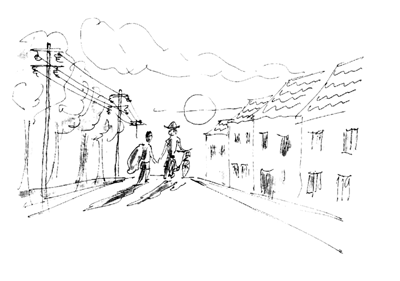
A haven of dreams When he woke up he found the Swan had left him a message. “Hope is NOT something you can see, you have to wait for it. There is Faith, Hope and Trust but the one to cling to when all else is lost is Faith.” The boy wasn’t sure this message comforted him very much. He shouldered his sack and went off to find refuse. When he saw a foreign lady carrying a plastic bag of rubbish he followed because he expected to find useful things: bent Spoons, empty cans, broken shoes, torn clothes, bottles, uneaten food. After the foreigner tossed her bag on the heap she watched the boy carefully scavenging and gave him a coin. ‘Thank you,” bowed the boy. He noticed the foreigner rode an old bicycle with a number painted on it. Now most foreigners drove white jeeps or large motorbikes. “Why do you ride a bicycle?” enquired the boy. “Because I can go slower,” smiled the lady.
Slow but sure… “You could walk.” suggested the boy. The lady shrugged and indicated the sun, “Walking is hot and I get tired.’ “It’s an old bicycle and very dirty,” commented the boy. The lady nodded. She surveyed the barefoot grubby boy standing knee deep in the garbage heap. “It’s not what it looks like that matters, it’s if it works well.” She added with a twinkle, “A bicycle is like a boy. He may be all shiny and clean on the outside but bad and lazy within or he may be dirty like you but good inside.” The boy laughed and felt immediately better than he had all morning. “Where are you going on your bicycle?’ he asked her. The lady indicated the row of numbers, “I rent it and each week I go to pay for it.” The boy was puzzled. for a bicycle was not so expensive you had to rent it.
Just passing though… “I like to rent, the lady explained. “I don’t want to pretend I actually possess anything.” The boy frowned. “What about your clothes? Do you rent them?” The lady laughed. “I just wear them out and then I can pass them on. You see we don’t own anything in this life. It’s a mistake to think of my this. my that. We’re all just passing through.” She thought for a moment. “You may not realise it but you are luckier than most. You have fewer things to worry about.” “But I worry about what I don’t have,” argued the boy, closing his sack. “Yes,” agreed the woman, ‘but the more we have, the more we want. We’re never satisfied. And the more you have the harder it is to get rid of. I stop myself when I see something I want and ask, But do I NEED it? I may want it, but do I need it? There’s an awful lot we don’t really need.”
Witch way to turn? “Do you need your bicycle?” teased the boy. The woman grinned as she rode off. “Yes, I do.” she insisted, but without conviction. But her smile remained long after she had gone and stayed to cheer the boy up. Every day. working and walking bareheaded beneath the burning sun the boy’s skin tanned dark brown. The other children laughed. “You’ll soon turn black,” they teased. “Oh, I don’t think so,” said the boy. Then one day he met a man who was far darker. “Gosh, you are dark,” he remarked. “I’m a black man,” said the man. “Not black, just dark brown.” ‘No, black,” insisted the dark man. ‘Then what am I’?” asked the boy peering at his own skin ‘You are white, which means your are better, superior to me.’
Black or white But why - just because I’m not so brown?” ‘Think about it.” suggested the black man. “The light side of life - fun, gaiety: the dark side - pain, misery. Day and night. Heaven and Hell. white and black.” The boy couldn’t accept this, “Why can’t we all just be called brown?’ he argued. ‘We are all brown after all, some light, some dark.’ “The world don’t work that way, son,” confided the dark man. ‘And we’ve got to live in the world. In this world you are either black or white. It’s decided the moment you are born. There’s no in-between. You see,” he continued, “although what we have in common is much more than what is different, people want to dwell on the differences. They feel safe set apart, so each group can learn to love to hate the other group. It makes them feel united and superior. I’ve just made you feel superior. I’ve told you you’re a white fellow. You ain’t at the bottom of the heap no more.”
Escape? “But if you’re a rich black man, driving a fine car with a big house. “Don’t make no difference,” interrupted the black man. “Deep inside, nearly every black man is trying to escape into a white man by pretending he can be and act like a white man.” The boy thought of the Black Swan and how magnificent it looked when it flew and he remembered what the Swan had told him about darkness. “It’s what’s in your soul that makes us dark or light,” he told the man, “your soul and my soul …” The black man smiled and patted him. “There you are right. Souls are kindred spirits. Outside doesn’t make no difference to the soul. It’s the soul that draws us to God. It’s on the wings of the soul that we will fly to God. It’s the soul goes marching on - not the body.” He saluted the boy and went on his way.
Souls go marching on… One day as he toured the street with a bigger companion they came on a row of gaily painted wooden huts fronting a muddy alley near the river. Pretty girls sat outside making themselves up and gossiping, while small infants rolled about on the ground. The girls winked playfully at men passing by. A man stepped inside and at once a pink hospital screen was placed to shield him from view. His companion tugged the boy’s arm. “Follow me,” he said and scampered round to the back of the hut. The plank wall was thin and full of cracks. The boys listened in silence. After a while the boy whispered, “What are they doing in there?” “Making love,” said his friend, “or pretending to.” “They seem to be making a lot of noise,” remarked the boy. “It’s how you get babies,” his companion informed him afterwards.
Fun for some? “Was that what they were doing then?” asked the boy. “No - they don’t want babies. They were just enjoying themselves.” He made a crude gesture with his hands. “That’s having a good time. When you love someone you want to do it to them.” “Did they love each other?” asked the boy innocently. “No, of course not,” his friend laughed. “They were just pretending to for a short time.” “Both pretending?” enquired the boy. “He was probably pretending more than she was. He pays her to pretend.” “Is it very costly to pretend this?” asked the boy. “I think it can be.” But his friend didn’t know for sure. “Anyway the more beautiful the girl, the more she costs.’ “And is the pretending any better?” “I suppose so,” his companion said. “But I’ve never had the money to try.”
Love or money? It seems a great mystery, thought the boy as he made his way to the river to swim. At the bank he met the old monk. “I met a brown man who claimed he was black but whose soul was white and would fly to God one day,” he told him. “God is a mystery,” said the monk. “Beyond everything made or created, that is or was, lies the Ultimate Mystery.” “There are lots of smaller mysteries,” the boy said. “What I saw just now was a mystery.” “What was that?” “I saw two people who were pretending to be making love and paying for it. It all seemed a mystery to me.” “The more they can keep it a mystery the longer the pretence can last,” said the monk. “Is God like that?” said the boy, thinking of the Black Swan. “Will God exist only if I pretend He is?” “No, God will exist whether you or I pretend or not. God is the ultimate and sacred mystery: unborn, uncreated, unknown, the creator, the knower.”
Searching for god “I know I was born,” said the boy, “but I do not know very much about anything.” “You are not expected to,” said the monk kindly. “You will not discover God trying to be wise or clever. After all no one can ever know the knower. God is a mystery and you will only come close to Him by sharing the mystery and entering the mystery. God is a bit like the City,” he added wistfully. “You think you know it and suddenly one day you see it in quite a different way. God has so many faces. God is spirit and if we seek Him we must seek Him in spirit and in truth. We cannot discover Him by knowledge or reasoning or science or technology, because God is the inspiration behind all science and all knowledge.” “People do so like to worship Gods,” the monk sighed, “but so often they are worshipping their own wishful thinking. Our Guru did not want the responsibility for how men behaved to depend on any supreme being but on people themselves.”
Wings so vast… “If I think of a supreme being,” mused the boy, “I think of the Black Swan and his wings so vast they enfold the entire world.” “But the Godhead,” corrected the monk, “is not any supreme being. The Ultimate Mystery is unbeing, not made or created but from which everything is made and created.”
|
||
|
Part 1 - Part 2 - Part 3 - Part 4 - Part 5 - Part 6 - Part 7 - Part 8 - Part 9 |










| . |
|


| . |
