
|

|
Boy, Doc and the Green Man Chapter One
Clutching the sky His earliest memory was of being cradled in a shawl across his mother’s back as she worked in the rice fields. He lay there warm and secure, linked to her every mood and movement. Bending low to plant the tender rice seedlings in the flooded paddy field she would talk to him, and sing and hum. Her words and her lullabies flowed into him as he stared up gurgling with joy, his chubby fists reaching to clutch the stray tresses of her hair, and the world of open sky watching and waiting above. Every day he shared with her, and she with him. bound together in a secret world where when she was happy he was happy. and when she was sad so was he. She always knew when he was hungry, and working him round in her shawl opened her blouse for him to press his tiny face into the soft loveliness of her breast. His bubbly lips pushed and suckled. and the flush of her milk powered him with all her love and strength. Homeward bound In the late afternoon when the shadows lengthened and she walked slowly home, a bundle of firewood balanced on her head, he bobbed gently to her stately sway, or later as she pounded rice with a long wooden pole in the grinding pot outside their home, he sensed the surge of her rising and falling like the tides of some ancestral sea within him, while high above the stars came out of hiding and moved in a noble and glittering procession across the vast dominions of the night sky. They named him Soy’. Boy’s father was a fisherman. His dugout canoe lay pulled up in the muddy shallows near their house. He had built the canoe himself, carving it out of a big tree he had chopped down in the forest. After hollowing it into shape he fired it inside to harden the wood. Then he fashioned bamboo outriggers, one for each side, to keep it steady in the waves. Finally he had cut paddles and a mast, and sewed together a sail from old rice sacks.
The open sea and sky Each evening he paddled the canoe down river, crossed the sand bar, raised the mast and sail, and set out over the breakers and onto the evening sea beyond. Near a small island he let down lines with baited hooks and fished all night. If it rained he sheltered under the patched sail. Sometimes he slept. He kept a lantern burning, and as Boy grew older he imagined he could see where his father was, but often there were so many other lanterns twinkling from so many fishermen that it was hard to be sure. As soon as Boy could walk he could climb, and scrambling up one of the tall coconut palms behind the house, each morning Boy watched for his father to return, If there was a breeze his father sailed upriver, and Boy could see the torn sail gliding inland above the wavy green horizon of rice fields. Then Boy dropped down, lit the fire in the lean-to kitchen behind their thatched hut and, propping a pot of water over the three stones, heated it up to make his father’s coffee.
Waiting for dad His father warned Boy about coconuts. “Be careful one doesn’t fall on your head!” “Has that ever happened to you?” Boy asked. ‘Yes — and it felt like a flash of blinding light. Fortunately it was only an old, dry coconut.” Then he showed Boy how to twist a strip of bark into a rope between his ankles, to help him grip the palm trunk more securely as he climbed. Their house stood raised on stilts a little way back from the river. It was shaded by five tall coconut palms, a big dark-leafed mango tree, and a clump of giant bamboo. The roof and walls were made of thatch sewn in strips from fronds of sago palm. The floor was split bamboo. There was no furniture; sleeping mats woven from split sun-dried pandanus leaves lay rolled up and stored at one end. Before his father came up from the boat, carrying mast and sail, Boy had the mats spread out for him to rest on, coffee brewed strong and sweet in a glass, and some loose tobacco ready to be rolled in a screw of dried husk.
To the toilet Boy followed his father everywhere. His mother already had another baby to care for and Boy knew, as if by instinct, how to look after it — rocking the tiny hammock it slept in when his mother was cooking, singing to it as his mother had sung to him, feeding its tiny mouth balls of cooked rice with his fingers, and leading it out to the little hut perched over the stream that was their lavatory. Boy copied his mother grinding chillies on a stone slab; grating dried coconut and mashing it with water to make curry; gutting, scaling and baking fish in banana leaves. He copied his father sharpening knives, cutting bamboo, baiting hooks, knotting lines, and as he grew stronger and sturdier he joined him in digging up the paddy fields when the monsoon rains came each summer.
Off to market Most mornings any big fish his father caught were purchased by housewives waiting eagerly at the river mouth for the fishing boats to return. The rest he brought home, or Boy’s mother carried them in a basket to sell in the town market. It was a two-hour walk to town. To be there early they left home before dawn. Boy helped carry the beans and tomatoes, chilli peppers and spinach his mother grew on a patch of land behind the house. Sometimes there were spare eggs or a scrawny hen to be sold. Following his mother to market Boy noticed the big houses, the fast cars and motorbikes. All his father owned was a rusty old bicycle with broken pedals. He didn’t seem to mind. He laughed, “I expect the rich have just as much to worry about as the poor.”
To give or take “I don’t understand WANT’ “ Boy said to his father. “Sometimes I want to give and sometimes I want to take.” “Compassion and desire,’ replied his father, “are two faces of the same man looking at the same thing. Both of them wear a smile, but while the smile of compassion is sweet and warm as the sun, the smile of desire is cold, a city light that switches its message on and off each time it wishes to deceive. The smile of compassion wants to give, the smile of desire wants only to get.” “So which face are you?” teased Boy. “You hardly ever smile at all.” “Ah,” laughed his father. “That’s because I was born during the rainy season when most of the time the sun is hidden by clouds. But it’s still there — or we hope it is.”
I wish Then he cautioned Boy, “Don’t think you are lesser than others because they appear to have more than you. And don’t get envious. That will only hurt you, not them. God loves you every bit as much as he loves the rich children.” “But why does he give them more than me?” His father hugged Boy. “God only gives you what you NEED, not what you WANT. How do you know you haven’t got more than them already?” Boy looked shamefaced at his patched clothes and bare feet, and compared himself to the richer children. His mother noticed his downcast eyes. She drew Boy to her and kissed him. She whispered., “It doesn’t matter what’s on the outside of you. It’s what’s inside that matters.” “Like enough food?” Boy suggested. No,” she laughed. “Like enough love.”
Thump-thump “Remember,” she added, ‘God dwells in everyone just the same.” “If God lives in me,” Boy asked her, “where does he live? Is there some special place for him to stay, or does he wander all over? And if he lives in me, how do I find him?” He dwells in your heart,” she said. When Boy touched his chest and felt it pounding, he wondered what exactly God was doing in there, and why? Boy’s first job on his own was to look after the family water buffalo. This big, gentle beast with mournful eyes hummed at Boy for attention, and licked him with her rough, wet tongue. A wooden bell was slung under her neck, and a rope halter passed through a ring in her nose. Each morning Boy led her out to graze.
Proud as a prince A stake tied to the end of the halter stopped her wandering into the growing rice. When she was not grazing she liked to wallow up to her ears in muddy pools. Boy and the water buffalo were often alone together all day, and he spoke to her as he would to a friend, confiding in her, telling her his news. The two were as close as Boy had once been to his mother, although sometimes it was difficult to decide who was in charge. When the water buffalo was hungry she made a high-pitched wheeze to tell Boy to move the stake somewhere new. And when it came to trampling the flooded dug-up fields before planting, it was hard to tell who was chasing who, the buffalo roaring and Boy shouting, both so covered with mud they needed a swim in the river to tell them apart. In the evenings when Boy rode home on her back he felt as proud as a prince riding a noble steed back from battle.
Shhh! One night each week Boy’s father stayed at home because the next day was the Holy Day and nobody worked. Instead they all dressed in their best clothes and went to the Holy Place. Here they sang and praised God, prayed and listened to people reading from the Holy Book. Boy’s father was one of the helpers. When he spoke he did not rage or roar as some did, trying to make people afraid of God. Instead he spoke very softly. When Boy asked why, he explained, “God never shouts. If you really want to hear God you have to be very quiet. It’s the same in the forest. If you want to meet the forest people” (the name they used for the great red apes that lived there) “you have to stay very still.”
Identity parade
“Where is God?” Boy asked him. ‘Does he live in the Holy Place? Is that why we go there?” Boy’s father smiled. “The Spirit of God lives in each one of us. You don’t have to go to the Holy Place to find God. If you don’t discover God in the very next person you meet — whoever it is — you may as well give up looking.” Boy was puzzled. “But everyone is so different,” he said. Boy’s father nodded. “God doesn’t want to enslave us; He only wishes to adopt us. We are free children of God — not servants. We are meant to have free choice. It’s up to us to decide our own fate or our own future.” After a pause he added wistfully, “God gave us this world to do with as we like. If we build it with God’s love it becomes a richer, lovelier place for everyone — man and beast. If we build it without God’s love, each day becomes a little more empty, a little more ugly.”
God drives Mercedes?
After that, Boy looked closely at everyone, but no matter how hard he looked he never saw God. All he saw were ordinary people like himself. Then he realised why. Of course, God wouldn’t live in a poor village; he would live among the rich people in the city. Next time he helped his mother selling their vegetables at the market he watched the rich people getting out of their cars to do their shopping. He was sure he would catch a glimpse of God. When Boy confided in his father, he only smiled. “God doesn’t worry about appearances,” he told Boy. “It’s by what a person is, not what he looks like nor where he lives, that God reveals himself. You’ll find the presence of God everywhere — in suffering just as in joy.” Although Boy didn’t quite understand what his father meant, he grew up convinced that God lived in everything.
Wake up It was his father who taught Boy to speak to God “But if God is in me already he must know all my thoughts,” Boy argued. “Yes,” explained his father. God does know but maybe you don’t. When you speak to God you will discover thoughts you weren’t aware of. You will discover the things that matter and the things that don’t.” When his little brother was old enough to look after the water buffalo, Boy learned to tap rubber from trees in the forest. His father made him a knife with the point turned so that he could cut a notch in the bark to release the milky rubber sap. Each morning before it was properly daylight Boy set off into the forest. When he reached his trees he greeted them boldly, “Wake up, trees!” he called. “It’s me, Boy. I’ve come to tickle you. So wake up and make me lots of rubber.”
Birds and butterflies When Boy carved a clean new cut above the older ones, rubber sap oozed Out and dripped slowly into the half coconut shell placed below to collect it. As Boy watched he thought of his mother feeding the new baby who had not so long ago been born, and who she now carried on her back in the same shawl Boy had once lived in, sipping the same milk from the soft. warm breasts. It was cool in the forest, but especially after the rain. Long-legged spiders spun webs stretching from tree to tree, and if he wasn’t looking Boy blundered into them snatching and tearing the sticky threads from his face and hair. Then he forgot that God had created spiders, and thrashed the webs with his stick, or shot at them with his catapult. There were butterflies too in the forest. and often when he sat by the stream they landed on him as if to drink from him. Sometimes his whole body was covered with dozens of small yellow butterflies, and he sat longer than he should so as not to disturb them.
What’s this? Boy soon got to know the forest and his trees. He thought of them as friends. He knew them apart which ones gave more sap, and which less. He talked to them, stroked their trunks, and lightly brushed their leaves. When the half coconut shells were full and the white sap had hardened to soft balls, he collected them all together, squashed them into two large lumps, and hanging these from each end of a stick he carried them over his shoulder down the mountain for his father to sell. One day when Boy had climbed higher than usual up the mountain, he came to a clearing with a small hut beside a stream. Although the hut looked neat and tidy, it was crudely constructed from sticks and leaves and stones. There didn’t seem to be a sawn plank anywhere. The clearing had been planted with yams, bananas and upland rice. Hollow bamboo pipes fed water from the stream to a washing place, and neat piles of firewood lay stacked under the overhanging eaves.
The green man Boy knew who lived here, even if he had yet to meet him. The people in the village called him the Green Man. Nobody was quite sure if he was human or a spirit. They all agreed that he was not one of the many demons that haunted the forest, but a kindly influence to be cherished and looked after. Boy knew that his father sometimes brought him rice. Boy soon met the Green Man. He was an odd- looking figure, bent and hunchback with misshapen legs. His clothes were even odder — bark and leaves and grass all woven crudely together but he had flowers sprinkled all over him, a warm welcoming smile, and a merry twinkle in his eye. The Green Man produced a young coconut, chopped the end off. and gave it to Boy to drink.
Anyone can make fire Boy didn’t feel afraid of the Green Man. He told him, “In the village they say you are a wizard that you cast spells and trap fire from lightning.” The Green Man chuckled. “Anyone can make fire if he has to.” Pulling a pointed stick from the rafters he squatted on the ground, his toes gripping a piece of wood placed over a machete blade. He cuta notch in the wood, and pointing the fire-stick into it he started spinning the stick between his palms. Soon smoke started to rise. He went on spinning until the notch glowed, then he deftly dropped a handful of dried blossoms over it, and blew softly until suddenly the blossoms burst into flame. The Green Man sat back, panting. “Yes,” he grinned, “anyone can make fire — with a wink he drew a battered cigarette lighter out of his shirt — “but it’s a lot easier with this!” “Why do you live here?” Boy asked him later, as he fed on some cold, boiled yams. “The forest is my friend,” replied the Green Man. “I like to live with my friends.” “It’s my friend too,” Boy agreed with his mouth full.
Don’t chop down your friends “So why do you hurt your friends?” teased the Green Man. “I don’t hurt them,” Boy defended himself stoutly. ‘You chop them down; you cut them to make them bleed. Is that the way to treat friends?” Boy reddened. “I don’t hurt animals,” he said cautiously, then, recalling his war with spiders, added, “not most of them,” The Green Man poked a stubby finger at Boy’s mouth. “Would you like a hook in your lip while you fought to get free?” “But,” protested Boy, “fishing and tapping rubber are the only ways we can make a living.” The Green Man nodded. “It’s easier for me; I don’t have your responsibilities. I know you like the forest. Don’t think I haven’t heard you talking to it.” “There is a story,” went on the Green Man, “that when God lived on Earth He planted a forest between two great rivers. He liked to walk in the forest in the cool of the day. He invited Man to share it with him, but Man abused God’s hospitality, and God cast him out. That’s why Man feels uneasy in the forest, as though he knows he’s not welcome any more.”
Getting and giving “Sometimes,” continued the Green Man, “when you walk alone in the forest you can feel the presence of God close by. There’s a holiness about the forest I never feel in the so-called Holy Places where, although they are crowded with people waiting for God, he never seems to arrive on time.” “Is that why you live here?” asked Boy, “to be near God?” “To be near my friends — the forest,” replied the Green Man. “They give me so much,” “I don’t understand,” said Boy. “Once, a long time ago,” said the Green Man, “I wanted a cigarette, but I had nothing to give in return. A man gave me a cigarette so I picked a blade of grass and offered it to him. Many years later an old man stopped me. He opened his wallet and took out a piece of dried grass. ‘I have kept it all these years,’ he said. ‘Your gesture was of much greater value than my paltry gift. I kept it to remind me how to give.’”
Forest gifts The Green Man continued, “When you give, give freely, as the forest gives: its cool shade, its fragrant scent, its tasty fruits, even its rubber. The forest expects nothing in return.” “I am not the forest,” replied Boy. ‘What can I give?” “You can give your friendship, your laughter, your songs, your smile.” Boy laughed. “But what use is that?” The Green Man said simply, “Does the forest know the pleasure of its cool shade, the flower its own fragrance, the wind its refreshing breeze? When you smile you may not know the pleasure it gives to rich and poor, old and young, even to God.” “How would I know if I met God?” asked Boy. “He’d probably be walking barefoot down the highway with a sack on his back,” chuckled the Green Man, “or working as a farmer or a carpenter but there would be something in his eye, in his manner, in his smile,” he emphasised, “that would reveal the God in him.” “How?” asked Boy. The Green Man pointed to the stream.
The source of everything “Every stream must have a source. But is it where the spring gushes from the rocks, is it the drops of rain falling on the mountain, or the clouds in the sky above? When we talk of God, what do we mean? For everyone it’s different. I think of God mostly as a force of creation and harmony that enters our lives and takes shape and form in everyone and everything to a greater or lesser extent.” “Everything?” said Boy, ‘Even plants and animals — but animals snarl and kill each other’?” “That’s their instinct,” said the Green Man. ‘We have a choice — but we snarl and kill each other much more and for no sane reason.” “What have we got?” he went on, tapping his twisted leg. “Our body — if we are lucky it will serve us well enough. Our mind which is concerned with day-to-day affairs, with this and that. Our character — some call it the soul — but so often this dominates us with prejudice when we should be patient, with desire when we should think of good deeds, with hatred instead of harmony, greed when we might be generous. Only the Spirit of God can heal all this and give us peace in our hearts.”
Just a smile “There is a story that God went in disguise to a poor man’s house begging for food. The poor man invited him in and shared his bowl of rice with him. Then God went to a rich man’s house and the rich man, seeing he was only a beggar, told his servants to give him the left-over rice outside the stale rice they throw to the dogs. Which gift do you think God valued more?” The Green Man didn’t wait for Boy’s answer but added, “A poor man giving only a smile may be far more generous than a rich man giving a fistful of money.” “Why?” asked Boy, puzzled. “It is the intention behind the giving that is more important than the gift. The rich man wants to show off how rich and generous he is; the poor man may be ashamed how poor his gift is.” Boy tried to follow the Green Man’s suggestion the next time he helped his mother in the market. At the entrance sat a filthy beggar in rags. He was always there, but this day when Boy smiled at him the beggar beckoned. “Perhaps he’s really God,” Boy wondered, although he did not think that even God would smell quite so strongly. “I’m a king in disguise” the beggar informed Boy. “Do you notice all the attention I get? People know, you see. Look how they keep a respectful distance. People recognise me as someone special. Usually they don’t dare to approach. Days go by before anyone has the courage to speak to me. But when I’m hungry I only have to enter the best restaurants and waiters rush to attend me, hurrying me out with as much food as I can carry.”
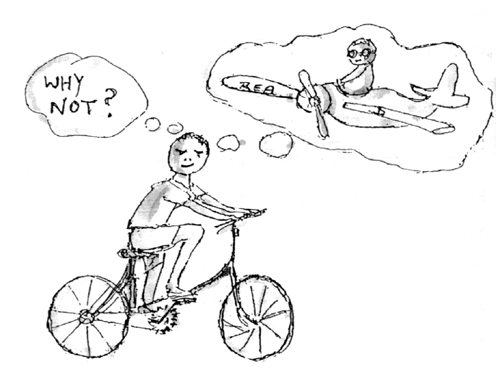
You need the 3R’s to fly The beggar yawned. “My only regret is that there are so few other kings of my quality to talk to.” “There is another ‘king’ at the other end of the market,” Boy ventured. “Oh, him,” the beggar sniffed loftily. “He is merely a beggar in disguise. I wouldn’t waste my time on him. What would we have in common, I ask you?” “Why did you speak to me?” enquired Boy. The beggar gave Boy a haughty glance. “A king can deign to address a commoner if he wishes. I hope you feel honoured.” One day the village teacher came to the house. “You must go to school,” he told Boy. “Why must I?” asked Boy. He liked the teacher and he didn’t want to be impolite, but he didn’t want to go to school. Besides, who would take care of his trees? The old teacher was a kindly man. After a lifetime of teaching he was not as convinced of the value of formal education as he should have been. “To read and write,” he declared, adding, “What do you want to be when you grow up?” “A pilot.” Boy chose the first idea that came into his head. “You’ll have to read and write to fly an aeroplane,” said the teacher. “Why?” asked Boy, “I can ride a bicycle without reading and writing, so why can’t I fly a plane?”
All mine! “Must I go to school?” Boy asked his father after the teacher left. It’s up to you,” his father told him. “I’m not sure they teach you much that matters in school. Most of what I learned there I forgot, and the things that matter I taught myself.” This decided Boy. He chose not to waste time and money dressing up in uniform, clutching books and going to school. Instead he continued to pull on his patched clothes and climb the mountains each morning to wake up his trees. But one day Boy confided to the Green Man, “The other boys laugh. They say if I don’t go to school I won’t learn to make money, and if I can’t make money I won’t ever own anything; but you don’t own anything and it doesn’t seem to bother you.” “Don’t get trapped into thinking you have to own things,” said the Green Man thoughtfully. “None of us really owns anything. I own the whole forest, but I haven’t paid a penny to anyone. You may build a high fence and write a notice saying ‘Keep Out’, and have a piece of paper saying it’s yours. But do weeds and rats read? And do you really want to live in a cage? Don’t be envious of others because they may seem to possess more than you. In fact they may have a lot less.”
Help! The Green Man went on, “And you won’t buy the things that really matter with money. You won’t buy love and affection. People think being poor is not having a big house and a fast car.” He shook his head. “Being poor is being unhappy, unhealthy, not loved, not cared for.” He grinned at Boy. “You just don’t know how rich you are.” If the Green Man had a single enemy, it was the Chain-Saw Man. Almost every day as Boy climbed the mountain he could hear the chain-saw at work somewhere in the forest, sometimes near, sometimes far away. The chain-saw sounded like a swarm of angry wasps. When Boy mentioned this, the Green Man grumbled, “I wish there was a swarm of angry wasps to chase him away. The trouble is, he is too greedy. Before he had the chain-saw and was simply a wood-cutter, we were the best of friends. He chopped down one tree at a time and sawed it into planks. I even rather liked to hear the sound of his axe. He was a kind, quiet, thoughtful fellow then, but once he got the chain-saw he turned into a butcher. He slaughters a whole area. You’ve seen it even trees he doesn’t need, healthy young saplings. He slays them too. ‘They get in the way,’ he says.”
Progress Sometimes Boy could not avoid meeting the ChainSaw Man, usually when he was resting and his chainsaw lay idle and silent. He was very proud of his chainsaw. Feel those steel teeth,’ he said. “Sharp, eh? Look at that blade I can cut down a tree in minutes that took me hours before. I could flatten this whole forest in a few months.” “But why would you do that?” Boy asked, shocked. Chain-Saw Man rubbed his palms together with a greedy smile. “Money what else? There’s a lot of people here don’t realise what an asset they’ve got until I tell them. ‘Trees are money’, I tell them once they’re chopped down.” “But once all the trees are down,” said Boy quite horrified, “what then?” Chain-Saw Man shrugged. “Plant some more, I suppose.” “But what would you do?” Boy insisted. Chain- Saw Man beamed. “I would get a machine to plough the paddy fields. With a machine I could plough more paddy fields in a day than a buffalo can in a month. Everyone would want to hire me.” “But what would happen to all the water buffaloes?” asked Boy. “Get rid of them, I suppose. Sell ‘em. That’s no concern of mine.” He glared at Boy. “It’s progress. That’s what it is. You must never get in the way of progress.”
‘I’ and ‘Me’
Deep in the forest lived two very old twin sisters. Around their hut they scratched a living from a little upland rice, yams, and bananas. At first glance it was hard to tell the sisters apart for they were both very stooped and very wrinkled. One called herself ‘I’, and the other, ‘Me’. ‘I’ bore a worried frown and was often quarrelsome, but Me’ was always kind and smiling. ‘I’ gave all the orders and Me accepted them. ‘I’ was forever explaining, arguing and complaining, while ‘Me never seemed to have much to say. She listened, watched and smiled. At first Boy thought she was dim-witted. ‘I’ said to Boy, “I do all the giving, and ‘Me’ does all the getting!” Nevertheless they got on very well together and Boy quickly realised that ‘I’ couldn’t do without ‘Me’, any more than ‘Me’ could do without ‘I’. The villages called them ‘witches’ in private, but more politely they were known as healers’. ‘I’ was better at healing that required talking, and ‘Me’ was better at listening. ‘Me’ had a less prophetic approach and was good with charms and potions. ‘I’ was more talented when it came to practical problems. She had somehow acquired an old television antenna, and with this subtle device would scan her patients until she diagnosed the secret of their malady.
Medical consultation Her use of this practical implement impressed everyone. Not even the expensive doctors in the town had one. The villagers paid for treatment with gifts of rice, fish, fruit or sago. The local people held the ancient sisters in high esteem. They were convinced the twins were equipped with supernatural as well as technological powers. When it came to more everyday matters, ‘I’ invariably issued the instructions, but she didn’t shirk her share of duties. If anything, she seemed to relish showing ‘Me’ how much better she could do everything. ‘Me’ never objected, but it was easy to tell if she approved. To make matters more confusing, ‘I’ admitted to Boy she wished she was more like Me’; “Less assertive, less convinced I’m always right!” She went on, “When we are young we have to be a bit, ‘I this, I that,’ don’t we, dear in order to assert our identity. But as we grow older there is this danger we will want to impose it on others. That’s what causes all the friction in the world. So we should subdue the ‘I’ in us. After all,” she added, “all the best things are those we receive; kindness, friendship, wisdom ... Aren’t they?” “But someone has to give them,” Boy suggested. “Otherwise how do you get them?” ‘I’ nodded. “How clever of you, dear. Perhaps the best solution is to give out as you would like to get back. To be ‘I’, as if ‘I’ were ‘Me’.” Boy turned from ‘I’ to ‘Me’ and back again. Both were smiling. It was harder and harder to tell them apart. As Boy ran home down the mountain he found himself repeating over and over, “Am I, I’ or am I ‘Me’? And which one do I want to be?”
Treehouse of dreams Not far from the village, the path through the forest led past a ruined hut perched in a tree and reached by a rickety bamboo ladder. Below it lay the blackened stones of a fireplace. Boy had never seen anyone in the treehouse but sometimes when he approached he could see smoke drifting up from a spent fire. He asked his father who lived there. “No one lives there. It belongs to a very old man” “The hut is falling to pieces,” said Boy. “It seems sad. I want to repair it for him as a surprise.” His father shook his head. “Don’t do that. He wouldn’t like it.” “Why?” asked Boy. His father smiled. “The old man was once a young man. He was always full of ideas, full of plans. But they came to nothing. In the end he had only his dreams. So he built the hut. It was a place he could come to and dream. We boys called it the ‘Shop of Dreams’.” “He sold his dreams!” asked Boy, startled. His father nodded. “Oh, they were wonderful dreams. Dreams of everything. As boys we would go and listen to him, quite entranced. We used to take him what gifts we could spare; fish we caught, and rice. That’s why it became called the Dream Shop.” “Now no one goes there,” remarked Boy sadly. “Have the dreams all gone?” “Dreams never die entirely,” said his father, rather wistfully, “as long as we want to believe in them.” After that, whenever Boy passed the lonely little hut he thought of all its treasures, tucked under its rotting thatch, stored on its crumbling floor. Treasure he could only dream of.
Making friends One day Boy climbed to the very top of the mountain. It was a hard climb. The streams got smaller and the path steeper. Once he met a family of ‘forest people’. They had long hairy arms and big barrel chests and deep-set, kindly eyes. They could swing through the trees like acrobats. They were very shy and Boy had to wait quite still until finally they approached him. “Where are you going?” they asked. “I’m going to the mountain top.” “But why are you behaving so oddly? Why are you so quiet? Why don’t you throw stones and shout at us like most people?” “Because I want to meet you,” said Boy. “I want to make friends.” “Why?” they persisted, not really believing him. “Because you are the people of the forest and this is your forest. You could teach me many things. Does anyone else live here?” “At the top of the mountain lives the Mountaintop Man, but we do not meet. He always looks into the sky and we look into the trees.” Boy thanked them, gave them some bananas he was carrying for his lunch, and continued his climb. Finally, quite out of breath, he reached the very top of the mountain where the Mountaintop Man lived.
Looking at The Mountaintop Man was very tall and thin. He had a long beard and a pair of enormous spectacles. His only shelter seemed to be a large umbrella. He didn’t notice Boy because he was always looking up at the sky. Boy had to tug his beard to get the man’s attention. “What are you looking for?” Boy asked him. “I don’t look FOR,” answered the Mountaintop Man. “I look AT.” “Is there a difference?” asked Boy. The thin man smiled kindly at him over his spectacles. “If you only look FOR, you will never be satisfied. You will always want more. If you look AT, you will be constantly filled with surprises and wonder. Only don’t impose your dreams on others,” he cautioned. “You will all be disappointed.” “Then why do you live up here?” Boy asked. “What’s there to look at up here?” The Mountaintop Man nodded solemnly. “I didn’t always live on the mountain top. I used to live in the City. I was constantly amazed and delighted watching the little acts of kindness and fellowship between ordinary people. But people can be unkind too, and it is sad to see suffering and to be unable to do anything about it.” “Is that why you left the City?” said Boy, “and came to live here?” The Mountaintop Man resumed his gaze at the sky. “I came here to look at the stars,” he replied. “But you don’t have to live all alone here. I can see the stars from our house if I want to.” “If you want to,” the man teased. “But how often is that? Here there is nothing else to see.”
What is mystical Boy tugged the beard again to get the man’s attention. “Excuse me, but what do you think of when you watch the stars?” “Why, I think of the journey of my own soul; the journey it must make when it is finally released from captivity.” “Is your soul in prison?” asked Boy, concerned. “The prison of the body,” said the Mountaintop Man loftily. “When I look at the stars I know that the starlight began its journey before this planet of ours ever existed.” “Does light travel, then?” asked Boy, astonished. “I thought it was just there.” “Nothing stays still,” remarked the man. “And when our bodies die, our souls finally released travel on into the unknown like the light from the stars.” “You speak of the soul as if it’s something real,” said Boy. The man nodded solemnly. “It is, in a mystical way.” “What is mystical?” The Mountaintop Man smiled benignly. “You’d better speak to the Hermit. He lives in a cave above the waterfall.” “Oh, I know him. Everyone says he’s mad.” “I suppose they say I’m mad, too.” “No,” Boy explained. “Because you study the stars people think you can tell their fortunes and may bring them luck. But the Hermit who lives in the cave, what does he do?” “He meditates.” “What’s that?” Boy asked, puzzled. The Mountaintop Man peered at Boy. “To think of nothing.” “What’s the use of that?” scoffed Boy. “You’d better ask him,” replied the Mountaintop Man, resuming his study of the sky. “But don’t expect an answer,” he added.
Trees have ears? Boy couldn’t think of an excuse to see the Hermit until he remembered ‘mystical’. Then he climbed the mountain to the waterfall. The Hermit was sitting outside the cave with a faraway look in his eye. “Excuse me,” asked Boy, “but what is mystical?” The Hermit gazed at him for a while before replying. “To believe in something unbelievable.” Boy was taken aback. “But why would anyone want to do that?” The Hermit grinned. “You sing to your trees, but trees don’t have ears to hear.” Boy laughed. “When I sing at home everyone puts their fingers in their ears. Perhaps it’s a good thing the trees don’t have any.” “Fingers?” smiled the Hermit, adding, “Do you believe in love?” “Yes,” agreed Boy. “Can you weigh it or measure it?” “You feel it,” said Boy, “inside.” “Of course you do,” agreed the Hermit. Then Boy, plucking up his courage, asked “What exactly is love?” The Hermit smiled. “Love isn’t exact. It’s a bit like rice.” “Like rice?” repeated Boy, astonished.
Love is rice
‘How many names are there for rice?” The Hermit asked him. “There’s paddy for the seedlings,” said Boy, “brown rice we harvest and take to the mill. Then there’s the white rice we boil up and eat.” The Hermit nodded. “Love has many more names. There’s the love in your heart and the love of friends, and the love two people share between their bodies.” “And is that the best?” asked Boy. “Just like the rice you eat is the tastiest?” The Hermit paused. “The rice you eat is soon gone and you only want more. Perhaps the best love is the sort that grows in your heart. You don’t have to keep feeding it.” Feeling more confident, Boy asked, “Isn’t it uncomfortable sitting here all the time? Don’t you get bored?” “It helps me to be detached,” replied the Hermit, “and to concentrate.” “Then you must be very wise,” said Boy admiringly. “You must know everything.” To his surprise the Hermit said, “F know nothing. I think of nothing.” He added, “Perhaps nothing is everything. Has it ever occurred to you, that although your thoughts may feel heavy they weigh nothing. Put together all your thoughts, songs, sounds, ideas, arguments, calculations, theories, dreams. How much space do they take up?” “None at all,” said Boy, puzzled.
Thinking of nothing The hermit suggested quietly, “Perhaps we should try to reach beyond thought.” Boy felt even more confused. “But my thoughts are what I am. They are me. And myself is all I’ve got.” “No,” said the hermit, “thinking only makes us dig deeper and deeper into ourselves. It’s a trap people fall into. Once we are trapped in ourselves we will never discover what lies outside, beyond.” Boy felt a little scared and wished he had never come. But he had one last question. “Do you pray?” he asked. “Who to?” “To God, of course,” said Boy. ‘What is God?” said the Hermit, and Boy tried to remember what the Green Man had told him, but the Hermit continued, “Is God some superhuman, we keep running to, begging him this, blaming him for that? We must be responsible for what we do, we can’t put the responsibility for everything on some personal presence we call God.” He paused. “I believe there’s a spirit of Goodness in all of us. If we discover it and use it, we will help spread compassion and also escape from the nets the world casts around us.”
Past many island “Life,” said the Hermit, “is like a journey down river to the Great Ocean beyond. During the voyage we pass many islands — people and places, where we can stop and stay for a while. Then we move on. Later we may wish to return, but we should not, otherwise we may never complete the journey.” Boy was puzzled again, “But if you discover a beautiful island where you will be happy forever after The hermit didn’t allow him to finish. “You will grow to realise that ‘Happy Ever-after’ is an illusion. Take care,” he cautioned. “We must not just look for the fat islands of joy and plenty. We will learn more from the lean islands of need and misery. Those are the islands which will touch our soul. Boy shuddered, but the Hermit continued, “Only if you experience human suffering will you learn. If you merely watch it from afar and wring your hands and declare how concerned you are, this will teach you nothing and you will continue your journey unaware.” “But I would be scared,” muttered Boy in a half whisper. The hermit watched him keenly. “Perhaps it is your destiny to suffer for a while.” Then he tried to reassure him by adding, “However much you may suffer in body, try to preserve the integrity of your soul.”
Trapped by the world
He went on, “We spend our lives plotting and planning, discussing this, discussing that, but later we can’t even remember what seemed so important at the time. Suddenly we get to the end of life, and what does all the worrying and bothering amount to?” He put out his hand to calm Boy, who was clearly upset. “You are young, and chasing dreams like shining wet shingle. But too soon the pebbles dry out dull. What was joy seems drudgery. As long as you are young the world will stay young with you. But if the dreams turn to despair, try to place yourself outside the cage of life, outside the traps of the world.” Boy jumped up to go. He was overcome with a sense of foreboding that seemed to hang in the dark clouds gathering over the mountain. The Hermit’s voice followed him. “Even if your body is trapped or crippled, try to let your spirit fly. Only then will you discover that Nothing is Everything, that Emptiness is Fulfilment” But Boy was already racing down the mountain, stumbling through tangled briars, slipping on rocks, tripped by creepers, falling head first into wet mud. Yet the Hermit’s cry still followed on the wind like a haunting whisper. “Whatever they do to your body, don’t let them steal your soul.” When he finally reached home, Boy was scratched and trembling, gasping for breath. He collapsed under a shady palm tree heavy with ripe coconuts.
The golf course Opposite the house a crowd had gathered. The village headman had called everyone to a meeting. A big car was parked nearby and outside stood a rich man from the city. The rich man told them he had bought all the land and was going to turn it into a golf course. “But it’s our land” objected the villagers. The rich man shook his head. “Not any more.” He produced a sheet of paper and waved it at them. “This explains everything.” The villagers were bewildered. “What does the paper explain?” they demanded, subdued and rather fearful. “It says the land is mine and you will have to go.” “But we have lived here all our lives,” they protested. “Our fathers and our grandfathers farmed this land.” The rich man smacked the sheet of paper triumphantly. “But none of you ever claimed it. No one ever registered this land in his own name.” “That was far too expensive,” they grumbled. “We were always told it was our land.” They looked to the headman, but he had nothing to say. “Who did you buy our land from?” demanded Boy’s father. “From the Govern ment. I bought it from the Government.” The rich man smiled blandly.
To play or to plant Boy’s father shook his head vehemently. “The Government has no right to sell our land. The Government never farmed this land. It was not theirs to sell.” Another man called out, “And what is a golf course?” The rich man gestured with a broad sweep of his arm, but before he could answer Boy’s father replied for him. “A golf course is where people play golf. They hit little balls across a field with sticks. The ball has to go down a hole.” “So why must it be so big?” asked the first man. “Why will not one field do?” A murmur of assent rose from the villagers. Someone also asked, “Do hundreds of people play together?” “No,” smirked the rich man knowingly, “only one or two at a time...” “One or two” everyone gasped. Boy’s father resumed: “And this land cannot grow rice any more?” “No,” replied the rich man, “because the grass must be very short.” “So all this land,” continued Boy’s father, “which now feeds hundreds, will feed no one.” The rich man began to get annoyed. “It is for people to play golf, not to grow rice.” “And that is more important?” said Boy’s father. “Is it more important for a few rich men to play games than for many poor people to grow their food and earn a living?”
Thief! By now the rich man was angry. He simply said, “You have a month to go. After that machines will come and flatten everything, If you cause no problem each family may receive some money. You see,” he concluded, “I am a generous man.” Boy’s father seized the rich man and led him firmly outside the crowd. “No, you are a thief. You steal our land and you steal our livelihood, just so that you can get richer. Don’t lie any more by pretending you are generous. You are a thief. Admit it.” And he let him go. Boy’s father did not go fishing that night. “Something may happen,” he warned them. “If they take our land,” he told Boy and his mother, “and if I am not here, you must pack up and sell everything. Then you must go up the coast to where we once came from. We have no land there, but it will be safer for you. Go to your Grandmother’s village. Her family will help you.” “But why will you not be here?” Boy asked. “I only said ‘if’ — ‘if’ I am not here.”
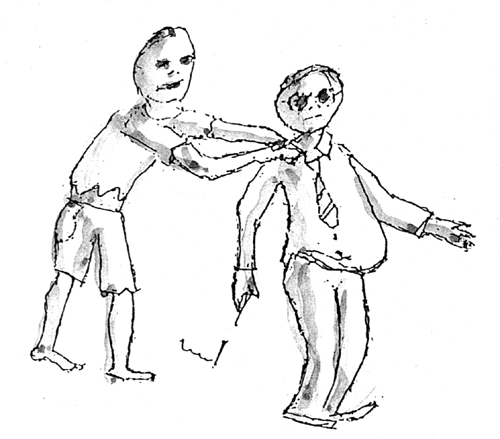
arrest Later that night police arrived. The rich man was with them. He pointed out Boy’s father. “This is the ringleader. He is the trouble-maker. Arrest him.” The police obeyed the rich man. Despite all the pleading from Boy and his mother, the police took Boy’s father away. He went quietly and with dignity. Next day the police returned. “There has been an accident,” the policeman said. “While we were questioning him he slipped and hit his head on a desk. We took him to the hospital but he died. You must sign this form.” And they pulled out a sheet of paper. But Boy’s mother was crying so much the tears blinded her and she could not read whatever it was she was signing. Later that day the body of Boy’s father was brought back. His face was covered with bruises. They buried him in the land near the Holy Place that was soon to be destroyed, along with the rest of the village. |
||





| . |
|


| . |
| . |
